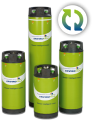







 Regenerate cartridges
 Ion exchangers, DI cartridges & regeneration service
Whether you require full demineralization, partial demineralization or the selective removal of specific ions, EnviroFALK matches ion exchange cartridges and resins to your water quality, application and required purity level. Once the resin is exhausted, we handle professional regeneration—from coordinated collection and type-specific processing to laboratory testing and on-time return delivery.

Ion exchangers for your application
Demineralized-water requirements vary from one application to another. Select your application area to go directly to the appropriate resins, cartridges and services.

Integrate DI water reliably into your process
Cleaning and rinsing processes, coating, metalworking and sensitive production steps require fully or partially demineralized water of consistently reliable quality. The key factors are the feed water, required volume, flow rate and permitted conductivity.
EnviroFALK matches the ion exchange cartridge and resin blend to these process parameters. Exhausted resins are separated by application, regenerated by type, tested and returned through our nationwide service network in Germany.
- Full and partial demineralization for industrial processes
- Application-specific resins and resin blends
- Scheduled collection and on-time return delivery
- Type-specific regeneration instead of premature replacement
Fill heating and cooling circuits to system requirements
Specially filled ion exchangers reduce hardness and salt content in fill and make-up water. This helps limit scale formation, deposits and corrosion risks, providing the basis for economical system operation.
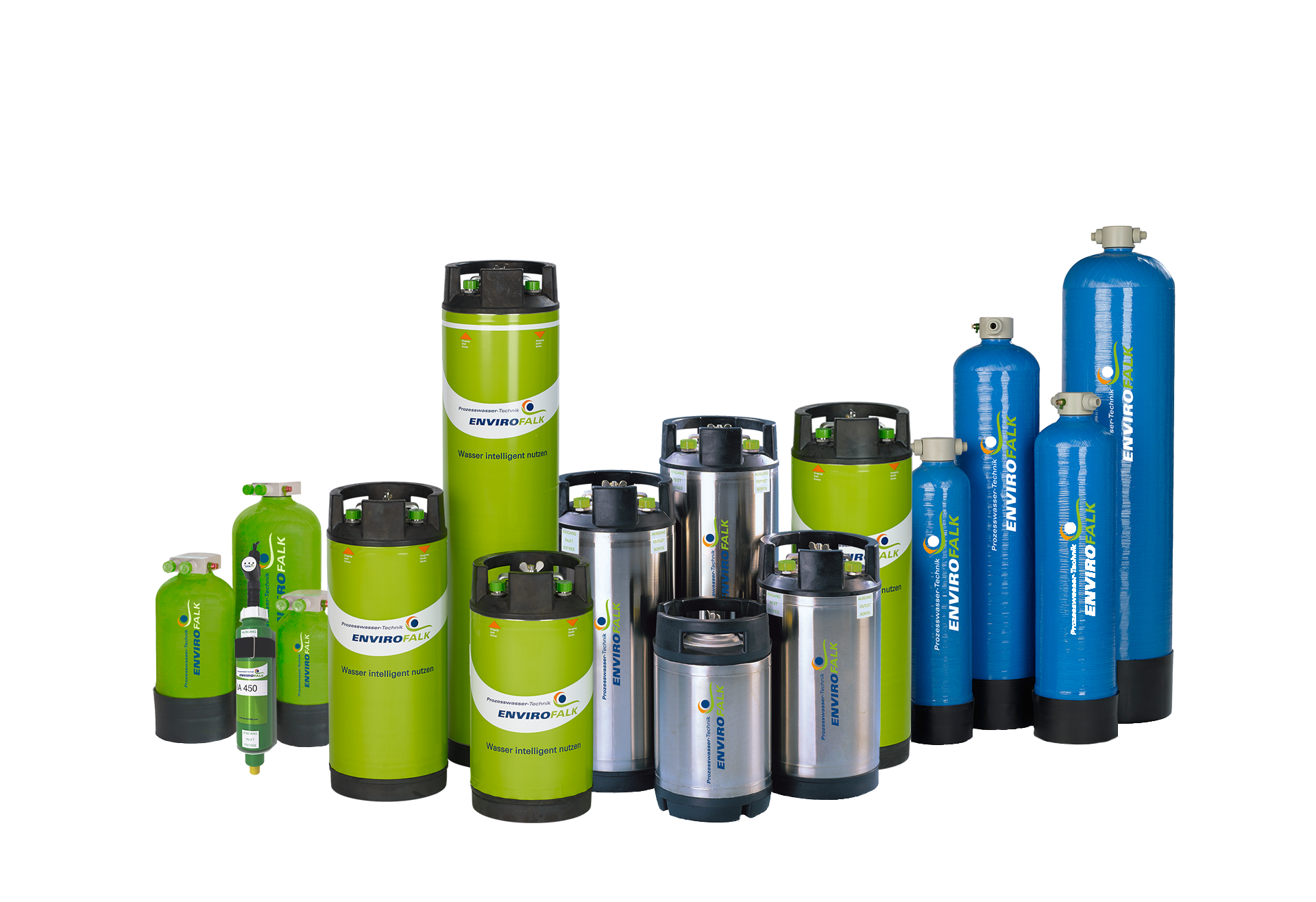
Depending on the property, GRP or stainless-steel cartridges containing durable special resins are used. Once exhausted, the resin is processed by type and the cartridge is returned ready for use.
- Filling, make-up water and circuit treatment
- Special resins for heating water that meets system requirements
- GRP and stainless-steel cartridges for properties of different sizes
- Regenerable resin instead of a disposable product
Reproducible water quality for sensitive processes
In cleaning, rinsing and disinfection, treated water is a direct quality factor. Laboratory washers, automated endoscope reprocessors, washer-disinfectors and clinical analyzers require consistently reliable purified or DI water quality.
EnviroFALK uses high-purity and ultrapure resin grades and keeps regeneration strictly separated by industry and application. A dedicated resin pool for hospitals and laboratories supports reproducible quality and long cartridge service life.
- Instrument reprocessing in CSSDs and RUMEDs
- Final rinsing for washer-disinfectors, endoscope reprocessors and laboratory washers
- Supply for autoclaves, sterilizers and analyzers
- Separate resin pool for laboratories and healthcare
Water quality for taste, washing results and system protection
Partially and fully demineralized water protects dishwashers, combi steamers, coffee machines and ice makers from limescale and scale deposits. At the same time, it improves taste and clarity and ensures spotless glasses and cutlery.
Cartridges and resins are matched to the specific kitchen appliance and local water quality. Food-grade resins undergo separate special treatment, including disinfection and incoming and outgoing inspections.
- Dishwashers and spotless glassware
- Coffee, tea and drinking-water systems
- Combi steamers, boiling pans and ice makers
- Separate treatment in accordance with LFGB and DIN 18879-1
Remove dissolved heavy metals selectively from process water
Selective ion exchangers specifically bind metal ions from electroplating rinse water as well as process, pickling and cleaning baths. Depending on the resin, metals such as copper, nickel, zinc or cadmium can be removed from the water.
Loaded selective resins require specialized, fully segregated treatment. EnviroFALK handles collection, regeneration and return delivery, tailoring the process to wastewater treatment and potential recovery of valuable materials.
- Selective removal of dissolved heavy metals
- Electroplating rinse water and process baths
- Special treatment in a separate regeneration process
- Collection and transport of loaded selective resins
Ion exchangers
Ion exchange resins absorb dissolved ions from the water and release other ions with the same charge in return. The type of resin used depends on the desired result—from softening and partial demineralization to the production of DI water and the selective removal of specific substances.
For full demineralization, cation and anion exchangers are often combined in a mixed bed. The water flows through the resin bed in the cartridge, removing most dissolved salts and reducing conductivity. If conductivity at the cartridge outlet rises above the limit defined for the process, the resin capacity is becoming exhausted.
The appropriate cartridge, resin blend and operating method depend on factors including the feed water, required water volume, flow rate, required purified-water quality and operating conditions. EnviroFALK considers these factors together and designs the solution for the specific application.
Cartridge regeneration
Exhausted resin does not automatically mean that the entire ion exchange cartridge must be replaced. If the resin and vessel are suitable for reprocessing, professional regeneration can restore the exchange capacity for the next use.
EnviroFALK processes ion exchange resins separately by resin type, industry and application. Subsequent quality control provides the basis for reliable reuse. This conserves resources, reduces material consumption and makes recurring cartridge changes easier to schedule.
Benefits:
- Reuse of suitable cartridges and resins
- Application-specific processing separated by resin type
- Documented testing before approval
- Scheduled collection and return delivery
- Optional advice on alternating operation, replacement cartridges or new resin
Separated by type, tested and traceable
Different processes place different demands on ion exchange resin. EnviroFALK therefore separates processing by resin type, industry and application. Dedicated resin pools are maintained for sensitive sectors, including laboratories and hospitals, medical technology, the optical industry, commercial kitchens and various industrial applications.
After regeneration, the agreed quality is tested and documented in our in-house laboratory. The resin is not reused until it has successfully passed approval. Suitable cartridges from other manufacturers can also be included in the service following a technical assessment.
- Separate resin pools: processing tailored to the industry and application
- Documented testing: scope of testing matched to the resin and process
- Manufacturer-independent: suitable third-party products following a technical assessment
How to get your cartridge back into service quickly
-
Step 1: Submit your order
Simply enter the cartridge type, quantity, collection address and your contact details in the online form. If you do not know the type, our customer service team will assist you.
-
Step 2: Arrange collection
The regeneration service coordinates collection with you and transports your ion exchange cartridges.
-
Step 3: Regenerate by type and test
The resins are processed according to resin type and application. The agreed quality testing is then carried out, for example for conductivity and capacity; depending on the application, the scope of testing can be expanded to include additional parameters such as TOC.
-
Step 4: Refill and return
After successful approval, the cartridges are refilled ready for use and returned on the agreed date. The agreed quality certificate documents the result.
You may also be interested in



Good reasons to talk to us
When we refer to ion exchangers, we mean the resin inside the ion exchange cartridge, often called the resin bed. This special resin exchanges unwanted ions in a solution for ions with the same charge—hence the term “exchanger”. In effect, the ions in the water trade places with the ions on the resin bed.
Where should we begin? High-quality ion exchangers have become indispensable in many different fields, from industry and commerce to laboratories and medical technology. The best way to discover more is to explore our website and see which industries rely on ion exchangers. If your industry is not listed, let us know. As versatile specialists with high quality standards, we find the right solution for every requirement.
The resins in an ion exchanger eventually become exhausted. At that point, they can no longer absorb ions from the water, preventing the production of fully demineralized water, also known as DI water. A specialized regeneration process can restore the resin’s efficiency and performance. There is no universal answer to how often regeneration is required, as this depends on several factors, including the type of ion exchanger, the concentration of ions in the water and water consumption.
As described above, the ions in the solution being treated exchange places with the ions on the resin. Eventually, however, the ion exchange resin has no capacity left. Regeneration effectively has to create free capacity again. In simplified terms, the process works as follows:
First, the resin bed is backwashed to remove suspended matter and loosen the bed. A special regenerant is then used to displace the foreign ions absorbed by the ion exchange resin and exchange them for regenerating ions (H⁺ or OH⁻ ions). Finally, the ion exchange bed is rinsed at the normal operating flow rate until the target water quality is achieved.
There are several ways to regenerate ion exchangers. Broadly speaking, a distinction is made between co-current and counter-current regeneration. In practice, counter-current regeneration has become the preferred method because, unlike co-current regeneration, it enables complete regeneration of the ion exchanger. The regenerant does not first have to pass through and displace the entire resin bed. The least heavily loaded layers are replenished with new ions first, while the most heavily loaded layers then receive the full dose of regenerant. This is not possible with the co-current method.
We will be happy to answer your questions. Modern water treatment using ion exchangers is one of our favorite topics, and we could talk about it for hours. If you would like to learn more or engage us directly, you will find our contact details on the left-hand side of this page. We look forward to hearing from you.
 powered by